02 · Embeddings
The One-Hot Baseline
The obvious encoding, and the two things it cannot do.
One column per word
The previous chapter established the need for numbers but left the exact values open. The most literal approach is to establish a fixed order for the vocabulary and assign every word a vector equal in length to that vocabulary. This vector holds a 1 in the word's own position and a 0 everywhere else. This structure is known as a one-hot vector. A five-word vocabulary makes it small enough to print in full:
| word | vector |
|---|---|
| apple | (1, 0, 0, 0, 0) |
| king | (0, 1, 0, 0, 0) |
| queen | (0, 0, 1, 0, 0) |
| man | (0, 0, 0, 1, 0) |
| woman | (0, 0, 0, 0, 1) |
This method requires zero manual decisions. No one has to judge how powerful a king is or how formal the word nevertheless sounds. The entire encoding derives strictly from the vocabulary list itself. That simplicity makes this approach worth examining because it serves as the absolute baseline that any new scheme must beat.
What it gets right
This setup gets two distinct things right.
The first success is that every word is entirely distinguishable. No two words share a vector. This guarantees no identity information is lost during the input phase. Regardless of what goes wrong later, the model always knows exactly which word it received.
The second success is that the lookup operation is computationally free. Imagine stacking the vocabulary embeddings to form the rows of a matrix
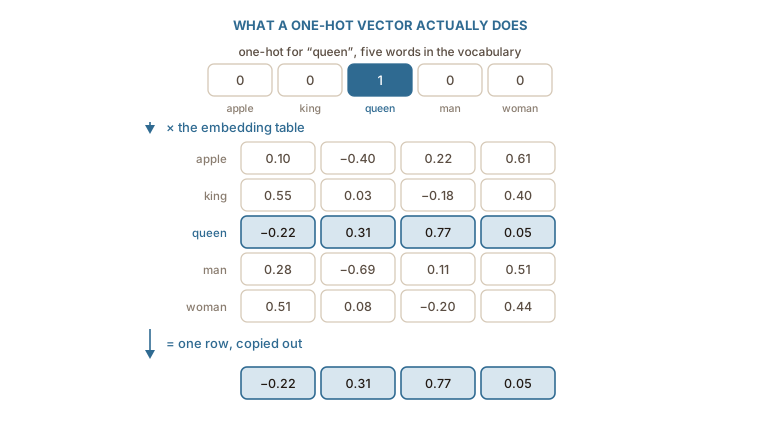
This selection trick is exactly why one-hot vectors remain important to understand. An nn.Embedding layer in PyTorch performs this exact multiplication with the arithmetic skipped. It simply takes an integer index and returns the corresponding row.
Where it fails
Taking the product of any two different one-hot vectors reveals a major issue. Every single position contains a zero in at least one of the two vectors. This forces every product to be zero, meaning the final sum is always zero.
import numpy as np

vocab = ["apple", "king", "queen", "man", "woman"]
I = np.eye(len(vocab))           # one row per word: the one-hot table
onehot = dict(zip(vocab, I))

print(onehot["king"] @ onehot["queen"])  # 0.0
print(onehot["king"] @ onehot["apple"])  # 0.0
print(onehot["king"] @ onehot["king"])   # 1.0

# every distinct pair sits exactly the same distance apart
print(np.linalg.norm(onehot["king"] - onehot["queen"]))  # 1.414...
print(np.linalg.norm(onehot["king"] - onehot["apple"]))  # 1.414...
Read the last two lines from the code above. The words king and queen differ by one feature and turn up in the same sentences; king and apple have nothing in common at all. The encoding puts both pairs at exactly
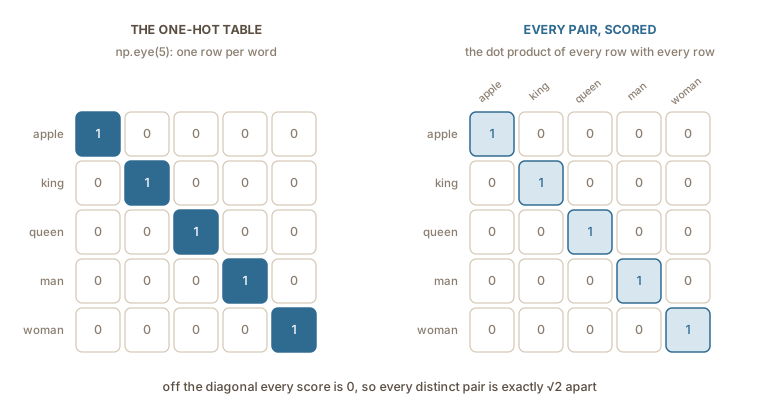
That breaks the first of the three requirements from the last chapter. There is no direction to move in, no sense in which one pair is closer than another, and nothing for a model to generalise from. A model that learns something about king learns nothing whatsoever about queen.
The second failure is size. The vector's length is the size of the vocabulary, so a realistic vocabulary of 50,000 entries gives every word a 50,000-dimensional vector holding a single 1. Feed that into a layer that produces 300 numbers and the weight matrix has 15 million entries.
The third is what happens at the edges. A word that was not in the vocabulary when the order was fixed has no position to put its 1 in. There is no nearest row, no partial match, no graceful degradation — the scheme simply has no answer.
What the failure points at
The actual problem is not that the vectors consist of zeros and ones. The fatal flaw is that the encoding dedicates an entire dimension to every single word and restricts each dimension to belong exclusively to that one word. Assigning one word per axis guarantees that no two words can ever share anything. Sharing requires two words to have a value in the exact same position, and this encoding structure strictly forbids that overlap.
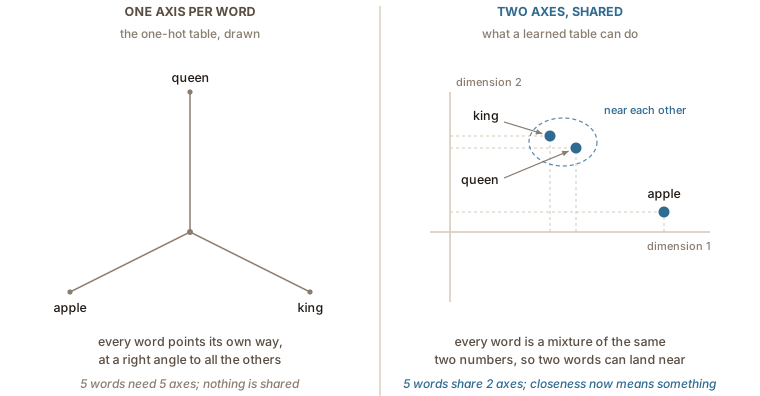
So the repair is to let words share dimensions. Give the space far fewer dimensions than there are words, and every word has to be described as some combination of them rather than getting an axis to itself. Words that behave alike can then take similar values in the same columns, and similarity becomes expressible for the first time.