02 · Attention
The Dictionary Analogy
Queries, keys, and values: a soft lookup where every entry is allowed to answer a little.
Give it a key, get back a value
The last chapter left the model asking the sentence a question without ever saying what asking means. The mechanism for it is not new, and nothing about it is particular to machine learning: it is a key-value store. We hand it a key, it hands us back a value.
Every entry is a pair. The key is what the entry can be found by; the value is what the entry gives us once it is found. A query comes in, it is compared against each key in turn, and the one that matches hands over its value. The comparison is exact in the sense that exactly one entry answers, and every other entry contributes nothing.
store = {
    "cat":    "a small carnivorous mammal",
    "mouse":  "a small rodent",
    "chased": "pursued at speed",
}

store["mouse"]                     # 'a small rodent'
store["what did the cat chase?"]   # KeyError
That is the shape the model needs, but interesting enough it is also where the analogy breaks.
Where it breaks
A real query is never literally one of the keys. Asking "what did the cat chase?" does not hand the store the string "mouse". It hands it something closer to the idea of the thing being chased, and nothing in the store is filed under that.
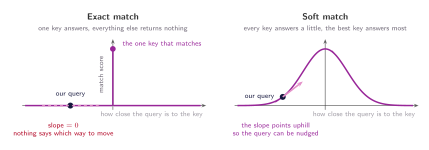
The deeper problem is that an exact match gives the model nothing to learn from. Either a key matches or it does not, so the score is one or it is zero, and a function that only ever returns one or zero has no slope. There is no direction in which to nudge the query to make the match better, because in this setup there is no better. There is only found and not found.
The image below illustrates both scenarios with a shared horizontal axis representing the distance between the query and the key. The left graph demonstrates an exact match where the score remains entirely flat at zero before abruptly peaking at the single point of agreement. The query rests on this flat region without any gradient. As a consequence, small adjustments do not alter the score. The right graph displays a soft match where the score increases gradually toward the key, placing the query on a continuous slope. An arrow indicates the direction of score improvement. This gradient provides the directional signal required for training rather than a simple binary outcome.
Let every key answer a little
The answer therefore might be to give up the one thing causing the trouble, the demand of exactly one entry answering the question being made. Instead of asking whether a key matches, ask how well it matches. What comes back is a number rather than a yes or a no.
Every key in the store gets a score. Those scores become weights that add up to one, and the store returns a blend of all the values, each weighted by how well its own key scored. Nothing is ever not found any more, and everything is found a little (that sounded a bit poetic).
This new approach actually broadens the original method rather than watering it down. If one key scores far above the rest, its weight goes to almost one and the others fall to almost zero, and the blend is essentially that key's value. The exact lookup is what a soft lookup looks like when it is very confident.
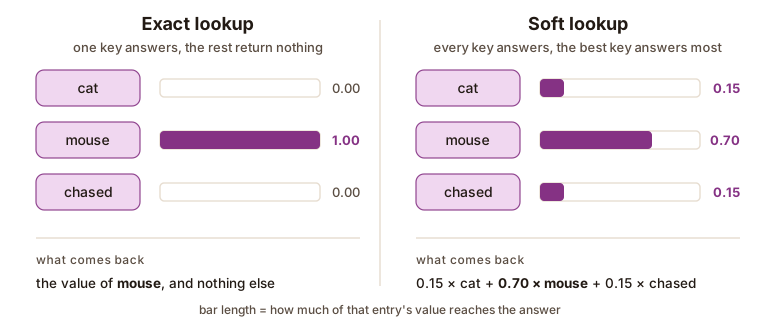
The figure below puts the same three-entry store under both rules. On the left the weights can only be 0 or 1, so mouse returns its value and the other two return an empty bar. On the right the same store hands back 0.15, 0.70 and 0.15, and what comes out is a mixture rather than a single entry. Nothing structural changed between the two panels: the entries are the same, the query is the same, and only the shape of the weights moved.
Query, key, value
Time to give the three things their names.
- Query — what is handed in, describing the thing being looked for. Written
- Key — what each entry offers up to be matched against. Entry
- Value — what that entry hands back once it is matched. Entry
Query, key and value. That is the entire vocabulary for everything that follows.
Something is still too simple here. The store maps strings to strings, and there is no arithmetic to do with a string: scores and weights mean nothing applied to "mouse". Everything in the store has to be a vector.
Swap the strings for vectors and look at what the store turns into. It is not something written by hand any more. It is the sentence itself. Every word becomes a key vector, which is how it gets found, and a value vector, which is what it hands over. Five words, five entries. The query is a vector too, and it comes from whichever part of the model needs to know something.
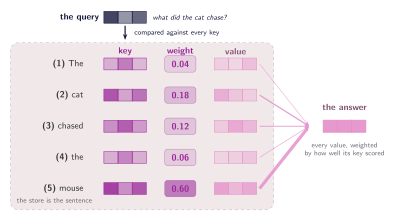
A word is no longer mapped to a written definition. It is mapped to numbers, and to two sets of them: a key vector and a value vector. Unlike a real dictionary, nothing is looked up from a fixed table. Each position in the sentence produces its own key and its own value, which is why the two occurrences of "the" are separate entries rather than one entry consulted twice — (1) The carries weight 0.04 and (4) the carries 0.06.
Two questions are still open. How is a query compared with a key to get a score out? And where do all these vectors come from in the first place? The first is the next chapter. The second has to wait, because it needs something not yet on the table.