09 · Attention
Positional Information
Attention cannot see order on its own: sinusoidal encodings, learned embeddings, rotary positions.
The sentence scramble
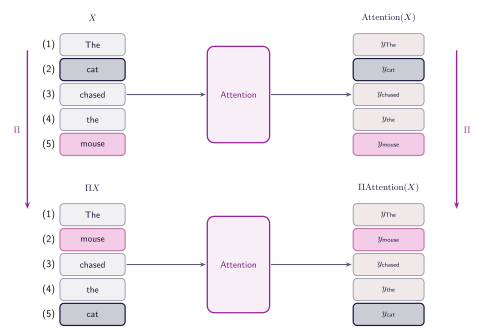
Feed the model The mouse chased the cat instead of The cat chased the mouse. Because
The numbers in this tutorial have been quietly breaking too. The embedding chapter said the is fetched twice and both copies come back identical. If that is so, both occurrences hand over the same key, and the query of (3) chased must score them equally — yet every figure gives the first the a weight of 0.04 and the second 0.06. Both cannot be true.
Formally, let
The softmax runs along each row and neither permutation changes the set of values inside a row, so it commutes with both. Then
Shuffle the input and the output is the old output, shuffled. This is permutation equivariance. The only part of the architecture that treats positions differently at all is the mask, and the mask says which words may be read, never where they sit.
Where order has to come from
Nothing is wrong with the mechanism. The trouble is what
The most direct arrangement is to write the position into the vector — one extra coordinate holding the index. It costs a single dimension, needs no training, and makes every row unique. It also fails, and so does every obvious repair:
- The raw index. A score is a sum of
- The index divided by the length. Now it lands between 0 and 1, but the third word sits at 0.6 in a five-word sentence and 0.03 in a hundred-word one, and the step between neighbours falls from 0.2 to 0.01. A rule as ordinary as look at the previous word has no fixed numerical form to learn.
- Multiplying instead of adding. Scaling the embedding by the position makes mouse at position 50 fifty times louder than mouse at position 1, so the score measures volume rather than meaning.
- One-hot the position. Every position becomes distinct and nothing else: neighbours sit as far apart as strangers, the width of the model depends on the length of the sentence, and a position past
One vector per position
Stop describing a position with a number. Give every position a vector of its own,
A vector buys what a coordinate could not. Spread over
What do those vectors hold? The simplest answer: build a table of shape
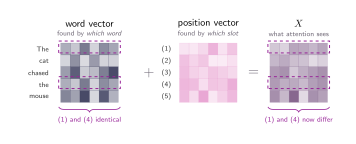
This works, and plenty of large models use it. The catch is the table's size.
Computing the vectors instead of storing them
Both problems come from storing the vectors. A table has finite capacity, and its rows have no intrinsic relationship. So compute the vector for position
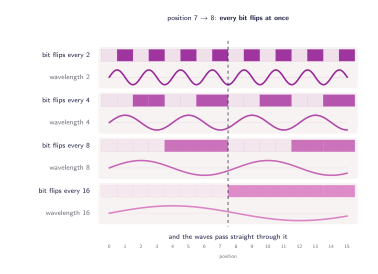
One option is binary. Write the position in base 2 and map its bits to coordinates. Each coordinate is 0 or 1, so it never overwhelms the content, every position is unique, and the bits alternate at increasing rates — every step, every two, every four. It is efficient, too:
It also has no gradient. Jumping between 0 and 1 leaves no slope, and the distances are erratic: 7 (
Keep what worked — coordinates changing at different rates — and drop the jumping. A flipping bit is a square wave, a continuous wave forced into corners. Replace each bit with a smooth wave of the same wavelength and the coordinate glides between
Sinusoidal positional encoding
Group the coordinates into pairs. Each pair
Here
The real test is not range but relative distance. Language runs on relations like the adjective just before this noun, and a query at position 10 looking back at position 7 should be doing the same thing as a query at 40 looking back at 37. The model should learn the relation once, not once per position.
That operation exists, and it is why the formula pairs sines with cosines. Shift a pair from
Every entry of that matrix is built from the offset
Where the matrix comes from
The angle addition formulas, with
Two such lines are exactly a matrix times a vector. The
Rotary position embedding
Notice what has and has not been shown. A shift is a fixed rotation, so a relative offset is something the model can express. Nothing makes it do so. The positional vector is added to
What the projections do to the structure
The score between positions
The scheme that took over keeps the frequencies and changes where they act. Let
The starting positions cancel. What survives is the gap. Relative position is no longer something the model is merely able to represent; it is the only thing the score can depend on.
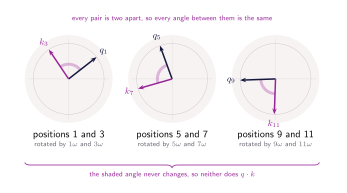
Two things come free. The rotation happens after the projections, so
What this finally explains
This chapter opened with two claims that could not both hold. The two copies of the come back from the embedding table identical, and every figure gives them weights of 0.04 and 0.06. Both are true now: the rows leave the table identical and do not stay that way, because something that depends on where they sit is folded in before attention sees them.
The scramble is settled too. The cat chased the mouse and The mouse chased the cat no longer produce the same vectors in a different order, because cat at position 2 and cat at position 5 are no longer the same row going in. The mechanism never changed. It simply stopped being handed a bag of words.
What sits around attention — the residual stream, the normalisation, the feed-forward layer — is the next chapter.