05 · Learning by Comparison
N-pair Loss
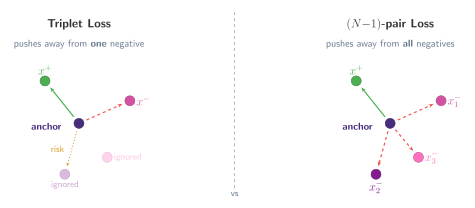
Pushing against all negative classes at once.
One negative at a time is too slow
"We propose to address the problem of slow convergence of triplet loss by allowing joint comparison among more than one negative examples — and propose the (N-1)-pair loss."
Sohn (2016) identifies a fundamental limitation of the triplet loss: each update only pushes the anchor away from one negative class at a time. When there are many classes, this is inefficient. The anchor might move away from one negative only to drift closer to another.
The (N-1)-pair loss (commonly called N-pair loss) fixes this by considering one positive and
Batch construction
The training batch is constructed by sampling
Each pair
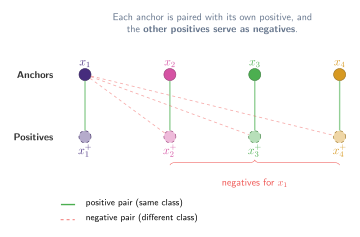
This is efficient: from
The N-pair loss
The loss for a single anchor
and the total loss over the batch is:
Let us unpack the terms inside:
- The
Connection to softmax cross-entropy
Let us walk through this step by step. First, recall the standard softmax cross-entropy loss for classification. Given
This can also be written as
Deriving cross-entropy from logits
The equation above computes the loss directly from raw, unnormalised logits. There is another form that starts from output probabilities. These two are entirely mathematically equivalent; they just represent different stages of the computation pipeline. Here is the step-by-step connection.
Start from the probability form
The general cross-entropy between a true distribution
Step 1: Apply one-hot encoding
In standard classification, the ground truth
Step 2: Substitute the softmax
The predicted probability
Substituting back:
Step 3: Expand using logarithm rules
Using
Since
Distributing the negative sign gives exactly the logit form:
Now, in the N-pair setting, define the "logits" as the dot-product similarities between the anchor
The correct class is
Now let us expand the N-pair loss. Starting from:
We can factor the subtraction out of the exp. Since
Rewriting the
Using
which is exactly the softmax cross-entropy loss with logits
This connection is important because it links metric learning directly to classification, and it foreshadows the InfoNCE loss, which generalises this idea further by adding a temperature parameter.
Triplet loss as a special case
When
which is a soft version of the triplet loss (using softplus instead of a hinge). So the triplet loss is a special case of N-pair loss with only one negative class. The power of N-pair comes from scaling this to
N-pair Loss in PyTorch
A minimal implementation. The loss reduces to a cross-entropy over the similarity matrix, where the diagonal entries (anchor-positive pairs) are the correct classes.
# npair_loss_example.py
import torch
import torch.nn as nn
import torch.nn.functional as F
import torch.optim as optim

# ── Synthetic data: sample N pairs from N classes ─────────────────

def sample_npairs(n_classes=8, noise=0.8):
    """Sample one anchor-positive pair per class."""
    # Random class centres on a circle
    angles = torch.linspace(0, 2 * 3.14159, n_classes + 1)[:n_classes]
    centres = torch.stack([angles.cos(), angles.sin()], dim=-1)

    anchors  = centres + noise * torch.randn(n_classes, 2)
    positives = centres + noise * torch.randn(n_classes, 2)
    return anchors, positives

# ── Embedding network ─────────────────────────────────────────────

class EmbeddingNet(nn.Module):
    def __init__(self, embed_dim=32):
        super().__init__()
        self.net = nn.Sequential(
            nn.Linear(2, 64),
            nn.ReLU(),
            nn.Linear(64, embed_dim),
        )

    def forward(self, x):
        return F.normalize(self.net(x), p=2, dim=-1)

# ── N-pair loss ───────────────────────────────────────────────────

def npair_loss(anchors_emb, positives_emb):
    """
    N-pair loss = cross-entropy over the similarity matrix.
    anchors_emb:   (N, d)
    positives_emb: (N, d)
    """
    # Similarity matrix: (N, N) — entry (i,j) = f(x_i)^T f(x_j^+)
    logits = anchors_emb @ positives_emb.T

    # Correct class for anchor i is positive i (the diagonal)
    labels = torch.arange(logits.size(0))

    return F.cross_entropy(logits, labels)

# ── Training loop ─────────────────────────────────────────────────

model = EmbeddingNet()
optimizer = optim.Adam(model.parameters(), lr=1e-3)

for step in range(3000):
    a, p = sample_npairs(n_classes=8)

    e_a = model(a)
    e_p = model(p)

    loss = npair_loss(e_a, e_p)
    optimizer.zero_grad()
    loss.backward()
    optimizer.step()

    if (step + 1) % 500 == 0:
        with torch.no_grad():
            logits = e_a @ e_p.T
            preds = logits.argmax(dim=-1)
            acc = (preds == torch.arange(len(preds))).float().mean()
        print(f"Step {step+1:4d} | loss = {loss.item():.4f} | match acc = {acc.item():.2%}")
A few things to notice:
- The entire N-pair loss is just
F.cross_entropyapplied to the similarity matrix. The diagonal entries are the correct classes. - The similarity matrix
anchors_emb @ positives_emb.Tcomputes all - No explicit margin parameter is needed. The softmax naturally handles the competition between positive and negative similarities.